(412) 946-8734






Insights from U.S. Film Crew + 3M industry veteran Jim Passage
When property managers, building owners, or security consultants start talking about ways to harden a facility, one topic shows up early and often: security window film.
People have heard of it, but few truly understand it.
Almost everyone has a question (or twelve) about what it actually does.
To simplify the noise, we sat down with Jim Passage, who spent 42 years working with 3M window film. Jim has been behind some of the most complex installations in the country—from the United Nations to Fortune 500 headquarters—and works closely with U.S. Film Crew on commercial projects today.
Here are the five things you really need to know before adding security window film to your building’s protection plan.
1. Security window film isn’t bulletproof—and that’s not the point.
Jim says this misunderstanding happens constantly:
“People ask for bullet-resistant film. Security window film will not stop a bullet. That’s not what it’s designed to do.”
If a project requires true ballistic protection, you’re talking about specialized glass.
Specialized glass runs $350–$500+ per square foot.
Security window film? $20–$40 per square foot.
The value proposition is different. Film is not about stopping bullets.
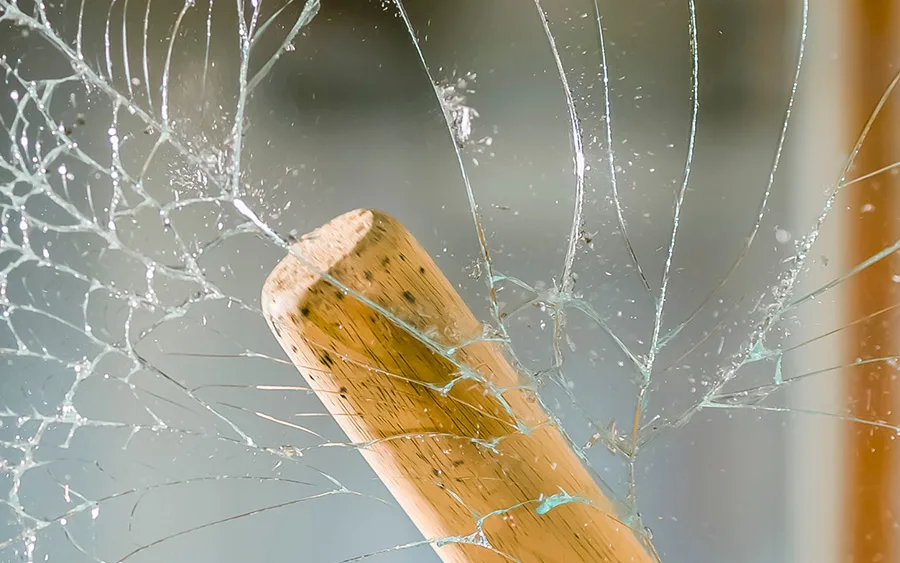
It’s about slowing the intruder down after the glass breaks, forcing them to fight a flexible barrier instead of stepping straight through a shattered window.
This delay, even 60–120 seconds, can change everything.
2. Its real job is buying your people time.
Security window film keeps broken glass in place and makes it significantly harder to create an opening large enough to enter through.
Jim puts it plainly:
“Security film is the one thing that can really slow down and buy time to save lives.”
Cameras show you what’s happening.
Access control denies entry until the glass is compromised.
But none of those systems slow an active threat once the glass breaks.
Security window film does.
That time buys:
- Evacuation or lockdown
- Police response
- A critical buffer between an attacker and your staff, tenants, or visitors
For commercial buildings, especially Class A offices, healthcare facilities, schools, retail, and distribution hubs, this matters.
3. Not all security window films are built the same.
Many competitors follow a simple rule: make it thicker.
Jim explains why that’s a flawed strategy:
“With thick polyester films, you’re just piling layers. Once a tear starts, it rips straight through. There’s no elongation.”
3M took a different approach:
Ultra S800 (micro-layer construction)
- Same thickness as basic 8 mil polyester
- Hundreds of cross-woven micro-layers
- Extremely hard to tear apart
- Industry’s most proven forced-entry film
- 14-year warranty backed directly by 3M
S2400 (polyurethane composition)
- Four times the tear resistance of S800
- Stretches and snaps back instead of splitting
- Ideal for high-value entry points
At times, commercial facilities may opt to use:
- S2400 for highest risk areas like main entrances
- Ultra S800 for the balance of ground level perimeter glazing
This optimizes both budget and performance.
4. Performance depends on the installer and the attachment system.
Glass breaks. The film holds it together.
But to keep the entire panel in the frame under force, you need a proper attachment system.
Jim explains:
“The film holds the glass. The IPA attachment system holds everything in the frame. It’s one system.”
A proper install requires:
- Interior application (the attack side is almost always outside)
- A clean, flawless bond between film, glass, and frame
- Correct bead thickness of attachment sealant (3/8″ for schools, 1/2″ for blast protection)
- Certified installers who understand forced-entry standards—not a GC with a caulk gun
This is where U.S. Film Crew earns its reputation. With decades of experience, strict internal training, and national commercial project work under their belt, our teams make sure your security film actually performs like security film, not decoration with a false sense of safety.
5. It’s a long-term, low-disruption upgrade with serious staying power.
The two questions commercial clients ask most often:
How long does it last?
Ultra S800: 14-year warranty
S2400: 10-year warranty
Real-world lifespan: 20+ years
Jim has installations from the early 2000s still performing today.
Will it disrupt tenants or operations?
In a word: no.
As Glenn from U.S. Film Crew puts it:
“Our teams are quiet, minimally invasive, and don’t create open holes in your building or depend on long lead times. Most customers don’t even know we’re there.”
No shutdowns.
No construction chaos.
Just a high-impact security upgrade completed while your building goes about business as usual.
Final Thought: Security window film is a practical layer of protection, not a magic shield.
It won’t stop a bullet, but it will slow down a threat, protect your people, and buy the critical seconds that matter most.
And for commercial environments it’s one of the most cost-effective security upgrades available.
If you want to explore options for your facility, U.S. Film Crew can walk you through:
- Product selection (S80 vs Ultra S800 vs S2400)
- Attachment system requirements
- Pricing ranges
- Installation timelines
- Demos, tear tests, and performance videos